

Couples across Mt Pleasant and Charleston often tell us, “We keep having the same fight.” It starts small and then jumps the tracks. Voices rise. Someone shuts down. Both people feel alone in the room. You’re not broken—you’re stuck in a pattern that many couples fall into. The good news: with a clear map and a few steady tools, most couples can change the pattern. Research backs this up, including a large review of couple therapy studies showing meaningful improvements for many partners.
What problem are we solving—and how do you know it’s time to see a marriage counselor in Mt Pleasant?
If the argument plays on loop—criticism and defensiveness, one person pursuing while the other shuts down—that’s a sign to get help. You don’t need to wait for a crisis. Early tune‑ups work. A marriage counselor helps you name the cycle, slow it down, and shift how you talk. Treatments with strong evidence, like cognitive‑behavioral couple therapy and Emotionally Focused Therapy (EFT), teach skills and help you reconnect so the same fight loses power.
- You leave most talks feeling tense or unheard.
- Small issues (dishes, plans, text tone) explode fast.
- Repairs don’t “stick,” and the next blow‑up comes sooner.
What happens in a first communication‑focused session with a Charleston marriage counselor?
First sessions are calm and structured. We get a quick picture of your story, set goals, and draw the cycle that trips you up. We use a mix of approaches. Family systems work helps you see the cycle you’re both caught in and the feeling under the fight; skills work (inspired by CBT and Gottman research) gives you simple moves you can use this week. Both have research support.
You’ll leave the first meeting with one or two tools to try at home—usually a brief “pause plan” and a softer way to start tough talks.
How do counselors help you map “the same fight” so you can interrupt it sooner?
We slow the film. What was the trigger? What did it mean to each of you? What did you do next? Seeing this loop on paper turns the blame game into a shared problem you both can solve. Then we build a short “pause‑script” you can use on the Ravenel Bridge in traffic, after a rough ER shift, or when a toddler melts down at bedtime.
Which patterns make conversations go sideways—and how do we replace them?
What’s a harsh start‑up, and how do we open gently instead?
A harsh start‑up is when a talk begins with blame or a global attack. It almost guarantees a bad ending. We practice a softer open: “I feel ___ about ___, and I need ___.” Be specific. Make one clear ask. This small change lowers defenses and sets you up to solve the real issue.
What is emotional flooding, and how do we downshift our nervous system fast?
Flooding is when your body says “too much” and your thinking brain goes offline. You might talk louder, interrupt, or go silent. We teach a brief time‑out (10–20 minutes), plus a calm‑down menu: slow breaths, a short walk, music, or a shower. Evidence‑based approaches like Integrative Behavioral Couple Therapy pair these skills with acceptance and empathy—so you can re‑enter the talk steadier.
How do we prevent criticism/defensiveness and the mind‑reading trap?
Swap “you always/never” for a precise request: “Could we plan bills on Sundays so I’m not worried during the week?” When you feel yourself mind‑reading what your partner thinks, ask instead: “Can you tell me what that meant to you?” These small pivots add up. Large reviews of treatment approaches show that when couples learn clear asks and practice de‑escalation, they communicate better and feel closer over time.
How does Emotionally Focused Therapy (EFT) repair communication when hurt runs deep?
When arguments keep circling the same raw spots, we shift from “facts and fixes” to the feelings underneath. In session, we slow moments down so each partner can say the softer, truer message—“I’m scared you’ll leave” or “I feel invisible”—instead of the louder complaint. EFT has a strong evidence base for building secure connection, with studies showing improved bonding and lower distress; see this review of EFT for couples for how working at the emotional level fuels better communication.
What is the pursue/withdraw cycle—and why does it repeat?
When one person protests the distance and the other protects by pulling back, both are trying to feel safe. We map that dance, name the trigger points, and practice new moves: slow eye contact, simple “I feel/I need” statements, and shorter turns. Over time, the protest softens and the retreat slows—because both of you feel safer.
How do we slow the argument to speak the real message underneath?
We’ll practice 10‑second “bottom‑line” shares: one feeling, one need, one request. Then we reflect it back in plain words. No rebuttal, no cross‑examining. Just getting the message across. When that becomes a habit, solutions stop feeling like surrender and start feeling like teamwork.
Which Gottman‑informed skills make day‑to‑day talks easier around Charleston?
How do we use softened start‑ups, repair attempts, and turning‑toward bids?
A gentle open sets the tone. Quick repairs (“Can we rewind?” “Let me try that again.”) keep talks on track. And tiny moments of attention—answering a text, a hand on the shoulder, a 10‑minute walk on the Ravenel—are daily investments. These small habits help couples maintain gains; programs built around skills and connection show promising effects on maintenance of relationship satisfaction.
How can “Local Love Maps” make us more resilient here in the Lowcountry?
Know the details of each other’s world: favorite Shem Creek spot, the tough parts of a MUSC night shift, the in‑law landmines before holidays, hurricane prep routines. When life gets loud, shared rituals—beach walks, Sunday planning, device‑free dinners—anchor you.
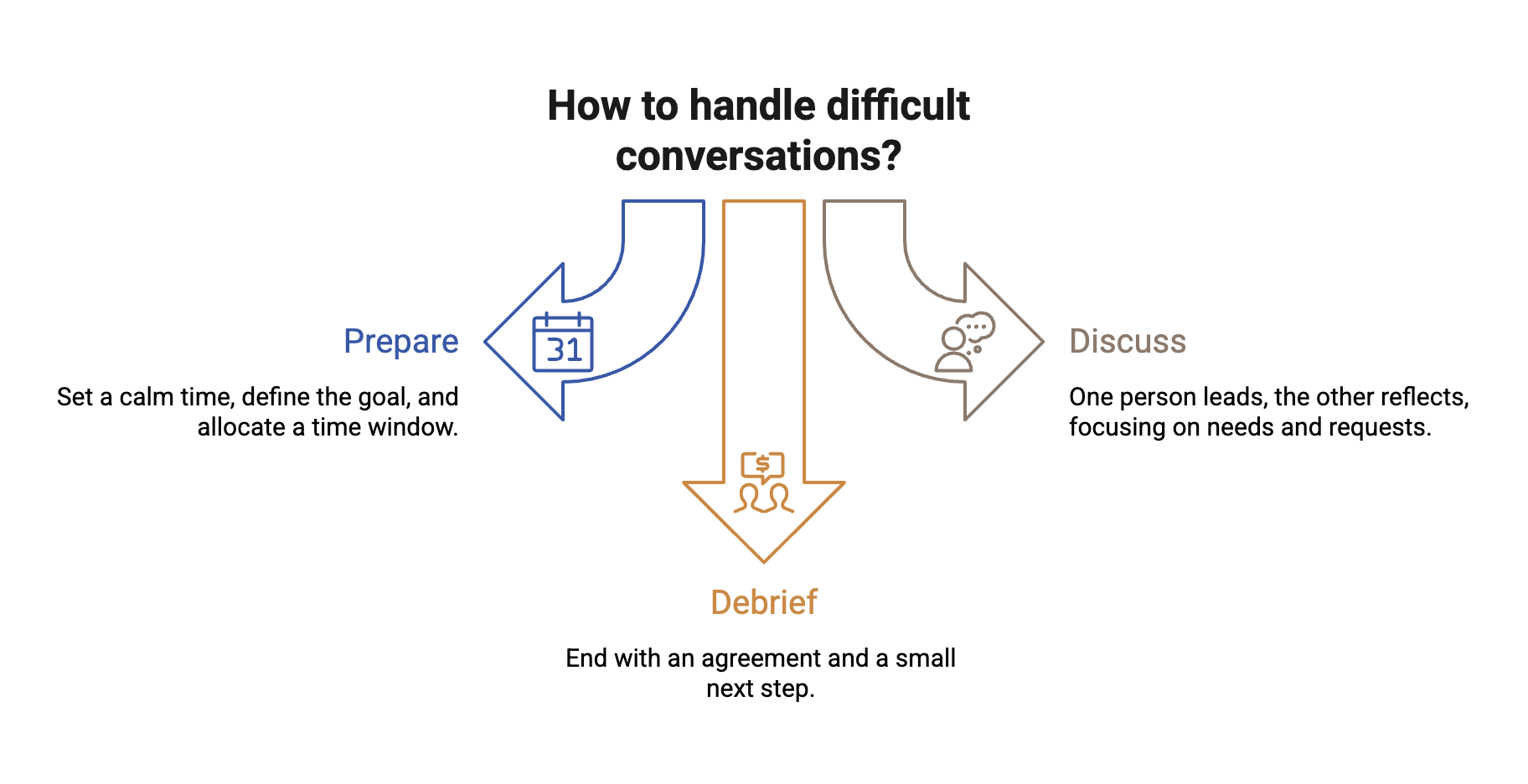
How do we handle the big topics—money, sex, parenting, in‑laws—without escalating?
What’s a simple three‑step agenda for hard talks?
Prepare: Pick a calm time, define the goal, set a 30–45 minute window.
Discuss: One person leads, the other reflects; then switch. Stay with needs and specific requests.
Debrief: End with one agreement and one small next step. If either of you floods, take a time‑out and follow the re‑entry plan below.
What’s a fair time‑out, and how do we re‑enter the conversation without reigniting it?
Pause: 10–20 minutes, max 24 hours. No ruminating or rehearsing your case. Do something that calms your body.
Reconnect: “I’m ready to talk. My main feeling was ___. My request is ___.”
Repair: Appreciate one thing your partner did well during the talk; agree on one change for next time.
How often should we meet, and what outcomes should we track?
Most couples start weekly or biweekly. Between sessions, practice the small skills that compound: soft starts, brief repairs, time‑outs, and short debriefs. We’ll track three markers: how often blow‑ups happen, how intense they get, and how quickly you recover. That rhythm lines up with current best practices in couple therapy that emphasize focused goals and steady home practice.
Can we do teletherapy sessions in Charleston and Mt Pleasant?
Yes. We see couples in person at our Mount Pleasant office and by secure video anywhere in South Carolina, so therapy can fit real lives—shift workers, parents, students, and medical teams from Daniel Island to James Island.
How do we start with a marriage counselor at Therapy Group of Charleston?
Reach out with a few lines about the pattern you want to change and any scheduling needs. We’ll match you with a counselor skilled in communication work. We’re out of network, and we file the insurance claims for you. First visits are focused, practical, and kind—so you leave with a plan you can try this week.
Frequently Asked Questions About Marriage Counseling in Charleston, SC
What is the difference between marriage counseling and couples therapy?
Very little in practice. Most therapists use the terms interchangeably: “marriage counseling” is the more common phrase for married couples, and “couples therapy” covers partners whether or not they’re married. Either one can be a tune-up before problems grow, not only a last resort.
Are there specific therapies effective for couples dealing with past traumas?
Yes. Attachment-focused couple therapy can help partners see how past trauma shows up in the relationship and build safer ways to talk about it.
How long does effective marriage counseling usually last?
The duration varies, but many couples find improvement within 12 to 20 sessions, depending on the challenges they face and their commitment to the process.
Can marriage counseling help prevent divorce?
While counseling cannot guarantee outcomes, effective marriage counseling provides couples with tools and understanding to address conflicts, reduce anger, and make informed decisions, potentially preventing divorce.